

Last updated · Dr. Jon Barnes, DDS
Dental X-rays, also called radiographs, show what your dentist can’t see in a mirror: decay between teeth, infections at the root tips and changes in the bone. They also make the difference clear: a healthy vs unhealthy teeth X-ray comparison can reveal problems long before they hurt. At Buffalo Creek Dental in Mustang, OK, we generally recommend checkup X-rays about once a year, with the exact schedule based on your history and risk. Here’s what X-rays reveal and why they matter.
Why Dental X-Rays Matter
Many dental problems are hidden. A cavity can start between two teeth where no one can see it. An infection can form at the tip of a root with no symptoms at first. Gum disease can quietly wear away bone. Dental X-rays catch these problems early, when treatment is usually smaller, simpler and less expensive.
For example, decay that develops between the teeth (interproximal decay) often can’t be seen during a visual exam. On an X-ray, it shows up as a dark shadow, which lets your dentist treat it before it reaches the nerve or breaks the tooth.
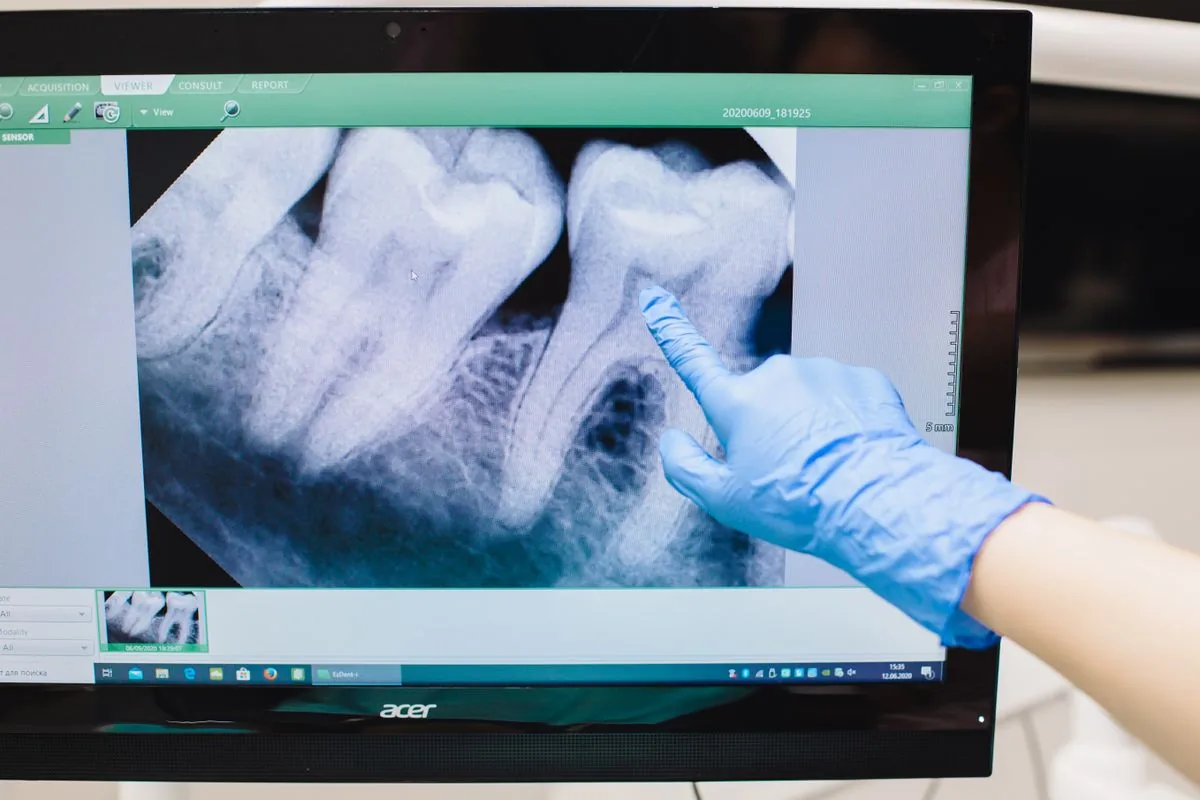
Healthy vs. unhealthy teeth on an X-ray
On a dental X-ray, dense structures such as enamel, bone and metal fillings show up white or light gray, while softer or missing tooth structure shows up darker. That contrast is what lets your dentist spot problems that can’t be seen in the mirror.
Healthy teeth usually show:
- A bright, even layer of enamel over slightly grayer dentin
- A narrow, dark pulp canal running down the center of each root
- Jawbone that surrounds the roots evenly and sits close to the necks of the teeth
- A thin, even dark line around each root, where the ligament holds the tooth in place
Possible warning signs include:
- Dark spots or shadows in the enamel, between teeth or under an old filling, which can mean decay
- A dark area around the tip of a root, which can be a sign of infection
- Bone that sits lower than normal around the teeth, which can point to bone loss from gum disease
- Teeth that are impacted or coming in at an angle
An X-ray is always read together with an exam, so a spot on an image isn’t a diagnosis by itself. If you have questions about your X-rays, ask at your next checkup in Mustang.
Tracking Changes Over Time
Another reason for regular dental X-rays is to compare images from year to year. Side-by-side comparisons show whether a small spot is growing, whether bone levels are stable and whether older fillings and crowns are still sealed. That history helps Dr. Barnes recommend treatment only when it’s needed and simply watch areas that are stable.
X-rays can also show changes in the jawbone itself, such as bone loss from gum disease, cysts or other growths, so they can be evaluated and treated early.
Common Types of Dental X-Rays
- Bitewings show the crowns of the upper and lower back teeth together. They’re the best way to find decay between teeth and check bone levels.
- Periapicals show one or two whole teeth from crown to root tip. They’re used to check for infection or problems at the root.
- Panoramic X-rays show the entire mouth in one image, including the jaws, sinuses and developing or impacted teeth.
Are Dental X-Rays Safe?
Yes. Dental X-rays use a very small amount of radiation, and the area being imaged is small. We take only the images needed to diagnose and plan your care. For most people, the benefit of finding a problem early far outweighs the very low exposure. If you’re pregnant or think you might be, let us know so Dr. Barnes can decide which images, if any, are needed now. MedlinePlus has more general information about X-rays and safety.
How Often Do You Need Dental X-Rays?
There’s no one schedule for everyone. How often you need X-rays depends on your age, your history of cavities, gum health, existing dental work and any symptoms. People at higher risk for decay or gum disease may need them more often. People with a long history of healthy checkups may need them less often. The American Dental Association explains how dentists decide in its overview of dental X-rays.
At a first visit, X-rays are often taken so Dr. Barnes has a complete starting point. If you’ve had X-rays recently at another office, ask them to send copies to us.
Frequently Asked Questions
What does an unhealthy tooth look like on an X-ray?
Common warning signs include dark spots in the enamel or between teeth (possible decay), a dark area around a root tip (possible infection) and bone that sits lower than normal around the teeth (possible gum disease).
Can I skip X-rays if nothing hurts?
Many problems, including cavities between teeth and early infections, don’t hurt until they’re advanced. X-rays catch them while they’re still small.
How long does it take to get dental X-rays?
Bitewings take just a few minutes. A full set takes a little longer.
Do children need dental X-rays?
Often, yes, but how often depends on their risk and development. Our children’s dentistry page has more information for parents.
Schedule Your Checkup and X-Rays
If it’s been a year or more since your last dental X-rays, it’s a good time for a checkup. Book online or call Buffalo Creek Dental at (405) 353-1333 to schedule a visit with Dr. Jon Barnes. New to our office? See our new patients page.
We’re located at 201 S. Sara Rd., #140, Mustang, OK 73064, serving Mustang, Yukon, Tuttle and southwest Oklahoma City. Hours: Monday–Wednesday 8 a.m.–5 p.m., Thursday 7 a.m.–3 p.m., and Friday 8 a.m.–noon.





Comments are closed.